

Buying a home in Singapore is one of the largest financial commitments most people will make.
Depending on the property type and location, buyers may spend hundreds of thousands—or even millions—of dollars on an HDB flat, executive condominium or private residential property. On top of the purchase price, homeowners must budget for renovation, legal fees, financing, furniture and moving expenses.
It is therefore understandable that some buyers hesitate to pay for a professional defect inspection.
However, the better question is not simply, “How much does a defect check cost?” It is:
How does the inspection cost compare with the value of the property being protected?
Why Are Property Prices High in Singapore?
Singapore property prices are influenced by several interconnected factors. No single factor explains the entire market.
1. Singapore Has Limited Land
Singapore must allocate its limited land among housing, businesses, transport infrastructure, schools, hospitals, recreation, defence, water management and nature.
URA describes Singapore’s planning approach as one that optimises limited land resources while balancing current and future needs. Land scarcity does not automatically cause every property price increase, but it places a structural constraint on how much housing can be built—and where it can be located.
Homes near established transport networks, employment centres, reputable schools and major amenities may command higher prices because these locations are especially difficult to reproduce.
2. Housing Demand Remains Significant
Homes are not only financial assets. They provide security, stability and access to a particular neighbourhood and lifestyle.
Demand may come from:
- First-time buyers forming new households
- Existing owners upgrading to larger homes
- Families moving closer to schools or relatives
- Buyers seeking homes near workplaces and transport
- Investors and landlords participating in the private market
When demand is stronger than the number of homes immediately available in a particular segment or location, buyers may compete for a limited supply.
3. New Housing Takes Time to Complete
Residential developments require planning, design, approval, land preparation and construction.
Supply cannot be increased instantly when demand rises. Even when more sites and projects are introduced, several years may pass before completed homes become available.
The Government has maintained a substantial future private-housing pipeline, but the effect of new supply depends on when those units are completed and which market segments they serve.
4. Construction Is Expensive and Complex
The cost of a property includes more than the land and physical materials.
Development costs may involve:
- Architectural and engineering services
- Skilled labour
- Building materials
- Machinery and specialist equipment
- Safety and regulatory compliance
- Financing
- Project management
- Infrastructure and landscaping
- Marketing and sales expenses
BCA projected total construction demand of between S$47 billion and S$53 billion for 2026, reflecting continued high activity across Singapore’s built-environment sector. Strong construction demand can place pressure on manpower, contractors and project resources, although it is only one part of overall property pricing.
5. Buyers Pay for Location and Connectivity
Two similar homes can have very different prices because of their locations.
Factors that may influence value include:
- Distance from MRT stations
- Travel time to the city centre
- Nearby schools
- Access to shops and healthcare
- Future transport plans
- Remaining lease
- Floor level and orientation
- Development facilities
- Neighbourhood reputation
- Potential future redevelopment
Property prices therefore reflect both the physical home and the benefits associated with its location.
Are Singapore Property Prices Still Increasing?
Market conditions can differ between HDB resale flats and private homes.
URA reported that private residential property prices increased by 0.5% in the second quarter of 2026 after rising by 0.9% in the previous quarter.
For public housing, HDB’s flash estimate showed the resale price index declining by 0.3% in the second quarter of 2026. This followed several years of stronger resale-price growth and suggests that price movements may be moderating rather than rising uniformly across every housing segment.
These figures also demonstrate why homeowners should avoid treating “the Singapore property market” as a single market. Price movements vary by property type, location, age and individual unit characteristics.
Does an Expensive Property Mean It Will Be Defect-Free?
No.
A high purchase price does not guarantee perfect workmanship.
Property value is affected by land, location, demand, supply, lease characteristics and market conditions. Construction quality is a separate issue.
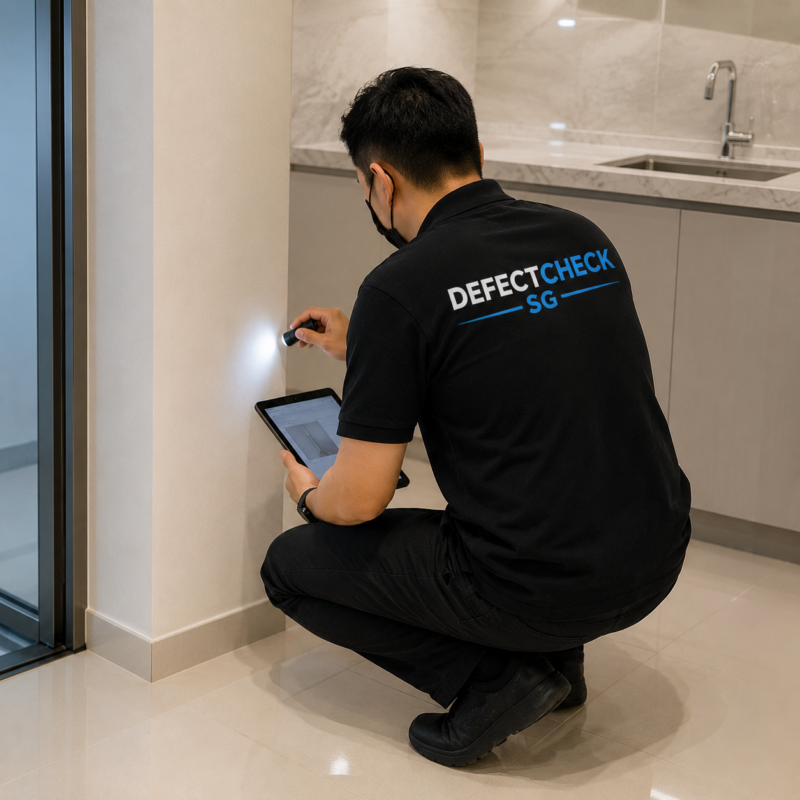
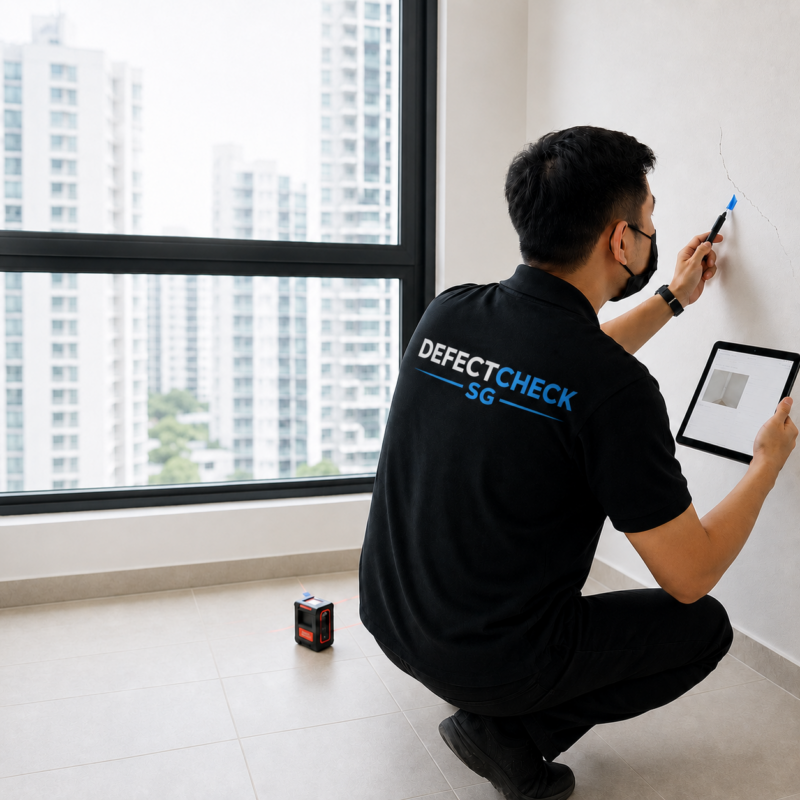
Even a newly completed property may have observable defects such as:
- Hollow or damaged tiles
- Uneven walls and ceilings
- Poor paint finishes
- Misaligned doors
- Windows that do not close properly
- Loose handles and fittings
- Damaged sanitary fixtures
- Water leakage
- Drainage problems
- Incomplete sealant
- Scratched surfaces
- Faulty supplied components
Some issues are cosmetic. Others can affect the use, maintenance or renovation of the home.
Singapore has also introduced measures to strengthen workmanship-quality checks and protect buyers’ interests, including expanded quality assessments and additional scrutiny of developers with poor construction-quality records.
These measures improve accountability, but homeowners should still inspect their own units carefully.
Property Price Versus Defect Check Cost
The cost of a professional inspection varies according to the property type, floor area, inspection scope, equipment used, reporting standard and whether reinspection is included.
Published examples for basic BTO inspections can be around S$120 to S$300, while condominium inspections may cost more. Broader market reporting has cited inspection fees between approximately S$300 and S$1,000 depending on property size and service scope. These figures are indicative only, and homeowners should compare written quotations carefully.
Consider these illustrative comparisons:
| Property value | Inspection cost | Inspection as percentage of property value |
|---|---|---|
| S$222,000 | S$250 | Approximately 0.11% |
| S$500,000 | S$300 | Approximately 0.06% |
| S$1,000,000 | S$500 | Approximately 0.05% |
| S$1,500,000 | S$750 | Approximately 0.05% |
The S$222,000 example is comparable to the starting price announced for selected four-room Standard flats in HDB’s June 2026 sales exercise, before applicable grants. Actual prices vary significantly by project and flat type.
The comparison shows that an inspection generally represents a small fraction of the property’s value.
That does not automatically mean every inspection package is worthwhile. The quality, experience and reporting standard of the inspection provider still matter.
Why Pay for a Defect Check After Spending So Much?
Precisely because the property is expensive.
When a buyer commits hundreds of thousands of dollars to a home, spending a small additional amount to examine its condition can be a reasonable risk-management decision.
A professional defect check may help homeowners:
- Identify visible defects before renovation
- Record the original condition of the property
- Submit a clearer defect list
- Reduce disagreements about when damage occurred
- Prevent carpentry or flooring from covering existing problems
- Coordinate rectification before renovation begins
- Recheck repaired areas systematically
- Notice issues they may have missed independently
A defect inspection cannot guarantee that every concealed or future problem will be found. It is generally limited to visible and accessible areas under the conditions present during the appointment.
Its value comes from providing a more systematic inspection and documentation process.
The Cost of Missing a Defect
The financial impact of a missed defect depends on its nature and when it is discovered.
A small paint imperfection may be inexpensive to correct. A leak hidden behind completed cabinetry can be far more disruptive.
Discovering problems after renovation may involve:
- Removing built-in furniture
- Replacing affected finishes
- Coordinating multiple contractors
- Delaying the move-in date
- Protecting furniture from repair work
- Investigating whether the original contractor or renovation company is responsible
The cost is not always limited to the repair bill. Homeowners may also lose time and face disruption.
The purpose of a defect check is not to create fear or classify every minor variation as a serious problem. It is to distinguish observable issues, document them appropriately and address genuine defects before they become more complicated.
When Should You Arrange the Inspection?
The ideal time is after receiving the keys but before beginning renovation.
For new HDB flats, the recommended sequence is:
- Collect the keys.
- Activate water and electricity where necessary.
- Inspect the unit.
- Document and submit defects.
- Allow rectification work to be completed.
- Reinspect the affected areas.
- Start renovation.
Homeowners should avoid installing cabinetry, overlaying floors or repainting the unit before the initial defects have been properly recorded.
Conclusion: A Small Cost for a High-Value Asset
Singapore property prices are high because homes combine limited land, construction, infrastructure, location and sustained housing demand.
However, a high property price does not mean the home will be delivered without workmanship issues.
Compared with the amount paid for the property—and the cost of renovation—a professional Singapore defect check is usually a relatively small expense.
For homeowners who want an organised inspection, photographic documentation and greater confidence before renovation, a defect check can be a practical way to protect a major financial commitment.
Arrange a Professional Defect Check in Singapore
Your property may cost hundreds of thousands of dollars. Inspect it carefully before covering its original finishes with renovation work.
Defect Check SG provides professional defect inspection services for BTO flats, HDB units, condominiums and newly completed homes in Singapore.
Call or WhatsApp: 80259645
Email: admin@defectcheck.sg
Service area: Singapore