


Singapore’s housing scene in 2026 is moving quickly.
More BTO flats are coming onto the market.
Some projects have shorter waiting times.
Homes are becoming smarter.
Renovation designs are becoming cleaner and more integrated.
And homeowners are thinking about their renovation much earlier than before.
But amid all the excitement over Japandi interiors, smart-home systems, concealed storage and full-height carpentry, there is one very practical question homeowners shouldn’t forget:
Have you actually checked the condition of the home first?
This is where a defect check becomes relevant in today’s renovation journey.
2026 Is a Big Year for New HDB Homes
HDB previously announced plans to launch about 19,600 BTO flats across three sales exercises in February, June and October 2026.
The June 2026 exercise alone introduced 6,952 flats across seven projects, including developments in areas such as Bishan, Bukit Merah, Sembawang and Woodlands.
What’s particularly interesting is speed.
HDB said 2,520 flats in the June exercise had waiting times of around three years or less.
For future homeowners, shorter waiting times don’t just mean getting a home sooner.
It also means renovation planning, budgeting and eventually BTO defect checking arrive sooner too.
August 2026: Some BTO Buyers Are Getting Their Queue Results
Here’s something especially relevant this month.
For applicants who participated in the June 2026 BTO exercise, HDB stated that shortlisted applicants would be informed of their queue positions in August 2026.
For these buyers, key collection may still be some distance away.
But many homeowners start planning early.
First comes:
Which unit?
Then:
Which ID?
Then:
What renovation style?
Then eventually:
When can I collect my keys?
But when key collection finally arrives, another question should enter the checklist:
“Should I inspect the home before renovation starts?”
In many cases, yes.
Renovation in 2026 Is Becoming More Integrated
Look at many Singapore renovation designs today and you’ll notice something.
There are fewer loose pieces of furniture.
Instead, we’re seeing more:
- Full-height carpentry
- Concealed storage
- Integrated TV feature walls
- Platform storage
- Built-in study areas
- Hidden doors
- Flush cabinetry
- Smart lighting
- Automated curtains
- Concealed wiring
- Large kitchen carpentry systems
Industry design guides for 2026 are also highlighting warm minimalism, multifunctional spaces, hidden storage and increasingly seamless smart-home integration.
Beautiful?
Definitely.
But there’s another side to it.
The more you cover, the less you can inspect later.
Today’s Beautiful Feature Wall Could Cover Tomorrow’s Defect
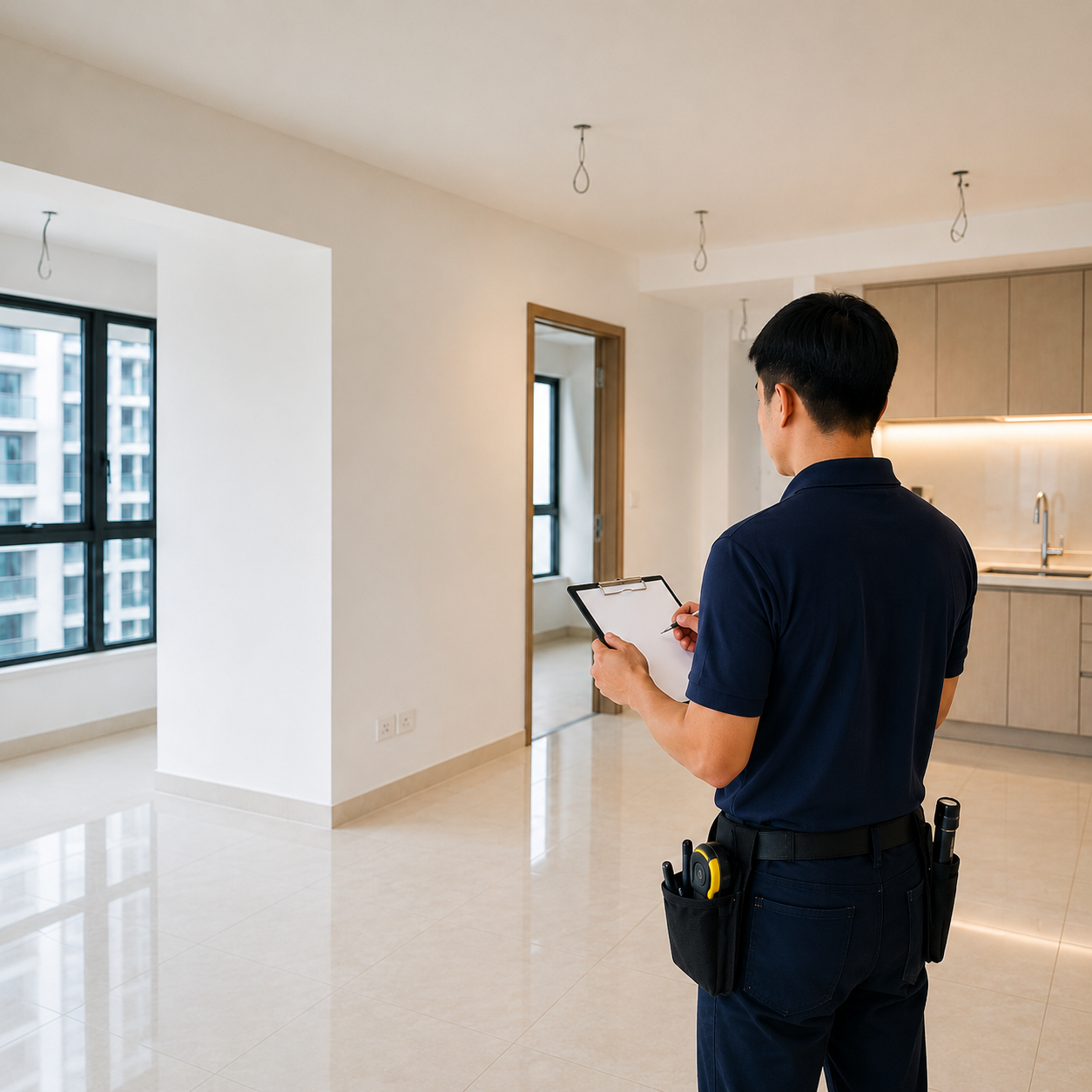
Imagine an empty BTO living room.
At key collection, almost everything is visible.
You can see the:
Wall → floor → skirting → windows → electrical points → ceiling
Now imagine the same room after renovation.
There could be:
TV console + full-height feature wall + storage cabinet + curtains + vinyl flooring + furniture
The home looks much better.
But many original surfaces are now hidden.
That’s why the period immediately after key collection can be one of the best opportunities to conduct a defect check.
The Same Applies to Your Kitchen
Modern kitchens increasingly use extensive cabinetry.
A kitchen may eventually have:
- Full-height cabinets
- Top cabinets
- Bottom cabinets
- Built-in appliances
- Tall pantry units
- Fridge panels
- Countertops
- Backsplashes
Before that installation happens, much more of the original unit remains visible.
During a BTO defect check, areas such as accessible tiles, walls, windows, doors, fittings and finishes can be inspected before renovation changes the space.
Once carpentry goes up, access may become much more difficult.
Smart Home Doesn’t Mean Defect-Free Home
Digital locks.
Smart lighting.
Automated blinds.
Motion sensors.
Voice control.
Air-conditioning automation.
Today’s home can be significantly smarter than the HDB homes many of us grew up in.
But smart technology doesn’t change the fundamentals of a property inspection.
You still need to look at the basics:
Are the tiles okay?
Are the doors aligned?
Do the windows operate properly?
Any cracks or visible workmanship issues?
Is sanitary fittings secure?
Are there gaps, chips or damaged finishes?
Technology can improve how we live inside a home.
It doesn’t replace checking how the home itself was handed over.
Hollow Tiles Haven’t Become “Old-Fashioned”
Renovation trends change quickly.
One year it’s industrial.
First Scandinavian.
Second Japandi.
Third warm minimalism.
But some of the things inspected during a defect check in Singapore haven’t changed very much.
Hollow-sounding tiles are one example.
When accessible tiled areas are still exposed, they can be systematically checked.
After cabinets, built-ins or other installations cover those areas, inspection becomes more difficult.
Sometimes the most important part of a modern renovation isn’t the newest material.
It’s checking what’s underneath it.
Homeowners Are Spending More Attention on Finishes
Social media has also changed homeowner expectations.
People now notice details they might have ignored years ago.
Cabinet alignment.
Silicone finishing.
Grout lines.
Laminate joints.
Paint finishing.
Tile alignment.
Door gaps.
Even a few millimetres of difference can become noticeable when you’ve spent months looking at perfect renovation photographs online.
That creates another important distinction.
A BTO defect check and a post-renovation defect check are not the same thing.
A BTO defect check generally looks at the condition of the property handed over to the homeowner.
A post-renovation inspection looks at visible renovation workmanship after the renovation has been completed.
They happen at different stages.
The 2026 Homeowner Journey Has Changed
The traditional journey might have looked like:
Buy Home → Collect Keys → Renovate → Move In
Today’s journey can look more like:
Buy Home
↓
Start Pinterest / TikTok / Instagram research
↓
Choose an ID
↓
Plan smart-home systems
↓
Select materials
↓
Collect keys
↓
Defect check
↓
Rectification
↓
Renovation
↓
Post-renovation inspection
↓
Move in
There’s simply much more going on.
And with more contractors, suppliers and systems involved, documentation becomes increasingly valuable.
Don’t Confuse “New” With “Perfect”
This is probably one of the biggest misconceptions among first-time homeowners.
New home ≠ zero defects.
Construction involves many different materials, trades and workmanship stages.
A defect does not automatically mean a home was badly constructed.
That’s precisely why defect inspection and rectification processes exist.
The objective of a defect check isn’t to prove that a property is bad.
It’s to identify visible issues so they can be documented and addressed appropriately.
2026 Renovation Trend: Hide Everything
This might actually be one of the biggest reasons to inspect early.
Modern interior design increasingly tries to hide things.
first he cables.
second the storage.
third the door.
fourth the appliances.
fifth the DB box.
sixth the study table.
seventh the clutter.
It creates a beautiful, seamless home.
But from an inspection perspective:
Don’t hide the defect too.
Before permanent finishes and built-ins go in, make use of the period when the home’s surfaces remain exposed.
Before You Build the Dream Home, Check the Home
Singapore homes are getting smarter.
BTO waiting times for some projects are getting shorter.
Renovations are becoming increasingly customised.
And homeowners have more design possibilities than ever.
But one principle remains remarkably simple:
Check first. Cover later.
A defect check before renovation gives homeowners a clearer picture of the property’s visible condition before contractors transform the space.
Because once the carpentry goes up, the flooring goes down and the furniture moves in…
your home might look completely different.
And that’s exactly the point.
DefectCheck SG
DefectCheck SG provides property defect inspection services for BTO flats, condominiums, resale properties and post-renovation homes in Singapore.
Our inspections focus on visible and accessible areas, with identified observations recorded through photographs, locations and descriptions.
Planning your renovation in 2026? Inspect what’s there before covering it with what’s next.