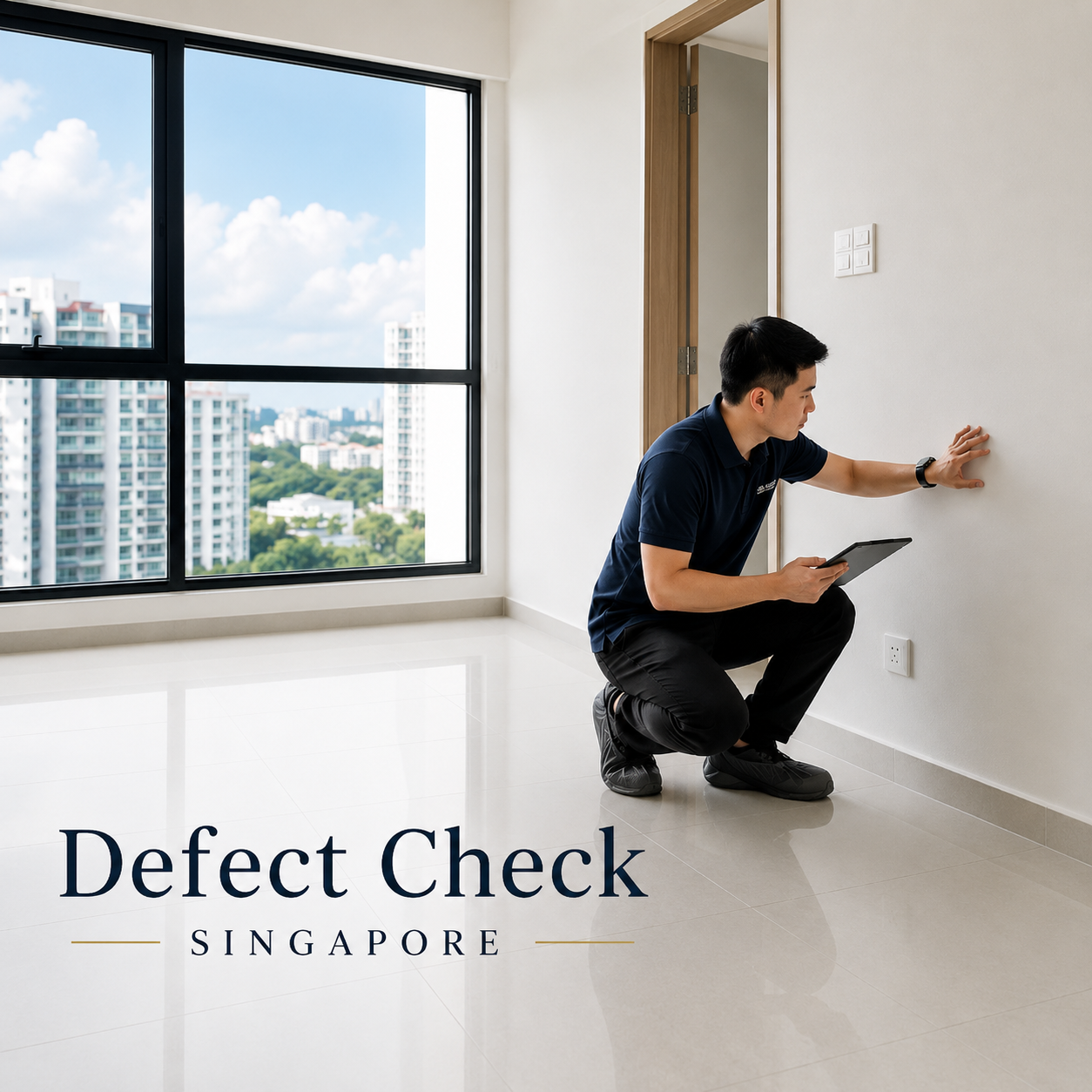


Your new BTO or condominium floor may look perfectly flat from a distance. However, a proper defect check can reveal hidden issues beneath the surface.
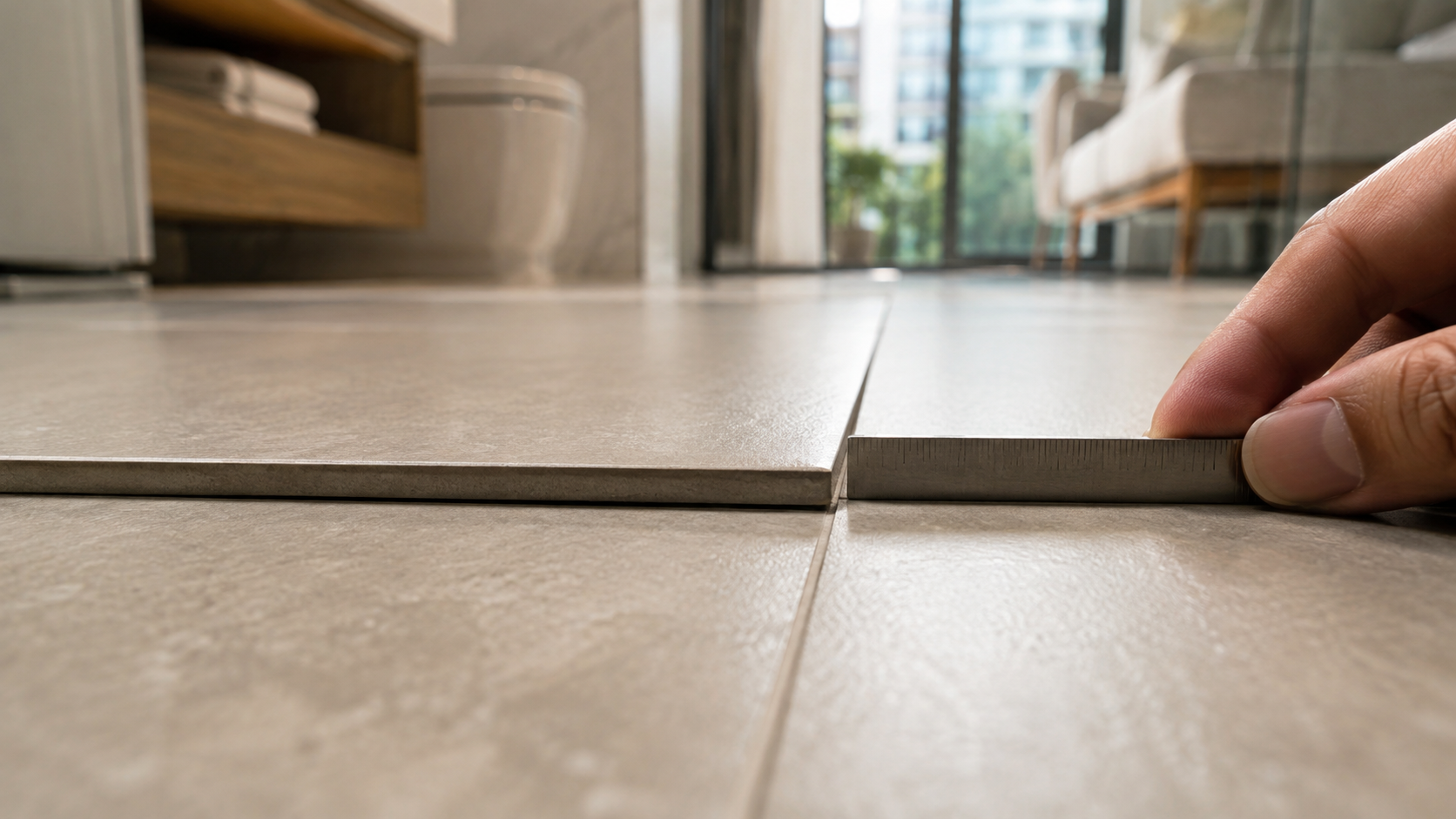
But when sunlight shines across the tiles, you notice something strange: one tile edge seems slightly higher than the next.
Is this normal workmanship variation, or should it be reported as a defect?
This condition is known as tile lippage, and it is one of the issues that may be identified during a professional defect check.
For homeowners in Singapore, there is actually a useful reference point. Under BCA’s CONQUAS 2022 quality standards for tiled finishes, lippage between two tiles should not be more than 0.5mm.
So that tiny difference you can feel under your feet may be worth a closer look.
What Is Tile Lippage?
Tile lippage refers to a difference in height between the edges of two neighbouring tiles.
Imagine two tiles installed next to each other:
Normal
Tile A ───────── Tile B
Both edges are approximately level.
Lippage
Tile A ─────────
─────── Tile B
One edge is noticeably higher or lower than the adjoining tile.
This is different from the entire floor being slightly uneven.
Floor evenness looks at the surface across a larger distance, while tile lippage focuses specifically on the height difference where two tiles meet.
BCA’s CONQUAS guidance distinguishes between the two: general floor evenness should not exceed 3mm over 1.2m, while lippage between two tiles should not exceed 0.5mm.
So Is 0.5mm Tile Lippage Acceptable?
Under the referenced CONQUAS 2022 workmanship standard:
≤ 0.5mm — within the stated lippage tolerance
> 0.5mm — exceeds the stated CONQUAS lippage standard
However, homeowners should understand an important distinction.
CONQUAS is BCA’s construction workmanship assessment system for building projects. A homeowner’s defect inspection is not the same thing as an official BCA CONQUAS assessment.
The standard is nevertheless a useful technical reference when inspecting tiled finishes.
“But 0.5mm Is So Small — Can You Really Notice It?”
Sometimes, yes.
Half a millimetre sounds insignificant on paper.
But tile lippage can become surprisingly visible depending on:
- Tile size
- Tile colour
- Grout joint width
- Surface finish
- Direction of lighting
- Location of the tile
- Number of neighbouring tiles affected
Large-format tiles can make uneven installation especially noticeable because long straight edges make height differences easier to see.
Lighting can exaggerate the effect too.
A tiled floor that appears fine at noon may look very different when morning or evening sunlight shines horizontally across it.
This is one reason a defect check should not consist only of standing at the entrance and looking around the unit.
A Simple Way to Spot Tile Lippage
Try this after collecting your keys.
Look across the floor from a low angle instead of looking directly down.
Natural light coming through the windows can highlight raised tile edges.
You can also gently run your fingers across adjoining tile joints.
If one edge feels noticeably higher than another, further measurement may be appropriate.
During an inspection, measurement tools can be used where necessary to assess workmanship against applicable tolerances. BCA notes that its Quality Mark assessments use both visual assessment and measurement tools when checking workmanship standards.
Is Tile Lippage the Same as a Hollow Tile?
No.
This is an important distinction.
Tile lippage
One tile edge sits higher or lower than the neighbouring tile.
Hollow tile
A tiled area produces a hollow sound when tapped, which can indicate that the tile is not fully bonded to the underlying surface.
A tile can therefore be:
Level but hollow
or
Well bonded but have excessive lippage
or even have both issues at the same location.
BCA’s CONQUAS standards for tiled floors separately address hollowness and lippage. The standards state that tiled finishes should have no hollow sound when tapped with a hard object and specify the 0.5mm lippage criterion.
That is why checking only for hollow tiles does not provide a complete assessment of tile workmanship.
What Causes Tile Lippage?
There are several possible reasons.
1. Uneven substrate
If the surface underneath the tiles is not sufficiently even, getting every tile into the same plane becomes more difficult.
2. Inconsistent installation
Differences in adhesive or mortar thickness can leave one tile sitting higher than another.
3. Tile variation or warpage
Tiles themselves may not always be perfectly flat, particularly larger-format tiles.
4. Poor alignment during installation
Tiles need to be positioned and levelled carefully while the bonding material is still workable.
5. Large-format tiles
The larger the tile, the more noticeable small differences in level can become.
The existence of lippage therefore does not automatically tell you exactly why the condition occurred. It identifies the observable workmanship condition.
Why Should Homeowners Care About Lippage?
Most people initially think:
“If the tile isn’t cracked, what’s the problem?”
There are several reasons to check it.
Appearance
Uneven tile edges can create visible shadows, particularly under directional lighting.
For a brand-new home, the difference may stand out once you start noticing it.
Cleaning
Pronounced edges can collect dirt along joints and may make mopping slightly less smooth.
Walking Comfort
Where lippage is significant, you may feel the raised edge when walking barefoot.
Furniture
Highly uneven sections may also become more noticeable when placing furniture across adjoining tiles.
Rectification Becomes Harder Later
This is arguably the biggest reason to identify the issue early.
Before renovation:
Tile → accessible
After renovation:
Tile → kitchen cabinet → countertop → appliances → carpentry
Rectifying one tile can suddenly become a much bigger job.
Tile Lippage Before Renovation vs After Renovation
Consider two homeowners.
Homeowner A
Collects keys → performs defect check → identifies excessive tile lippage → reports issue → rectification is reviewed → renovation begins.
Homeowner B
Collects keys → immediately starts renovation → installs carpentry → moves furniture in → notices uneven tiles later.
Both may have started with the same tile issue.
But Homeowner B now has a much more complicated situation.
There may also be questions about whether the condition existed before renovation or resulted from subsequent works.
This is why conducting a defect check before renovation can be valuable even when the new home initially looks good.
What Else Should You Check Around the Same Tile?
Finding one uneven tile shouldn’t mean looking only at that single joint.
Check the surrounding area for:
Hollow sounds
Are nearby tiles properly bonded?
Grout condition
Are joints filled consistently?
Joint alignment
Do grout lines remain straight?
Chipped tile edges
Has the raised edge already suffered damage?
Floor evenness
Is the issue limited to two tiles or part of a larger uneven area?
Water falls
In bathrooms and kitchens, is water flowing in the intended direction?
Ponding
Does water remain in areas where it should drain?
BCA’s CONQUAS standards for floors cover several of these issues independently, including evenness, wet-area falls, ponding, hollowness, joint consistency and tile lippage.
Can You Check Tile Lippage Yourself?
You can certainly carry out an initial visual check.
Walk slowly around the property and look at the floor from several angles.
Pay particular attention to:
- Living room tiles
- Kitchen
- Bathrooms
- Service yard
- Entrance areas
- Wall tiles
- Areas near floor traps
- Tile transitions
However, determining whether something falls outside a workmanship tolerance is different from simply noticing that it “looks uneven.”
That is where systematic measurement and documentation become useful.
Don’t Judge the Entire Floor From One Tile
Another important point: not every visible difference automatically means the entire tiled floor is defective.
The condition should be assessed at the relevant location.
For example, you might have 100 tiles that are generally well installed but one joint with noticeably excessive lippage.
The inspection should identify and document the specific affected location rather than simply declaring the whole flooring installation bad.
Good defect checking is about objective observation, not trying to maximise the number of defects found.
Tile Lippage Is Small — But That’s Exactly Why It Gets Missed
A cracked tile is obvious.
A missing door handle is obvious.
A leaking pipe eventually becomes obvious.
Tile lippage can be much more subtle.
You might walk across the same floor several times without noticing it.
Then one evening, sunlight enters through the window at a low angle and suddenly every raised edge becomes visible.
That’s why detailed workmanship issues are often discovered only when the property is inspected systematically.
Defect Check Before You Cover the Floor
Whether you’re collecting the keys to a BTO, condominium or another newly completed home, inspect the tiled areas before renovation starts wherever possible.
During a professional defect check, tiled finishes can be reviewed for issues such as:
- Tile lippage
- Hollow tiles
- Chipped tiles
- Cracks
- Uneven joints
- Grouting defects
- Surface damage
- Floor evenness
- Wet-area falls
- Water ponding
A new home does not need to look obviously damaged to contain workmanship issues.
Sometimes the difference between a smooth tiled finish and a questionable one is measured in less than a millimetre.
And when it comes to tile lippage in Singapore, 0.5mm is an important number for homeowners to know.
Arrange a Defect Check Before Renovation
At DefectCheck SG, we carry out systematic defect inspections for BTO, HDB, condominium and residential properties in Singapore.
Our inspections focus on visible and accessible workmanship issues and provide homeowners with documented findings that can be reviewed before renovation progresses.
If you’ve just collected your keys, carrying out your defect check early gives you the opportunity to identify issues such as tile lippage while the finishes are still fully accessible.